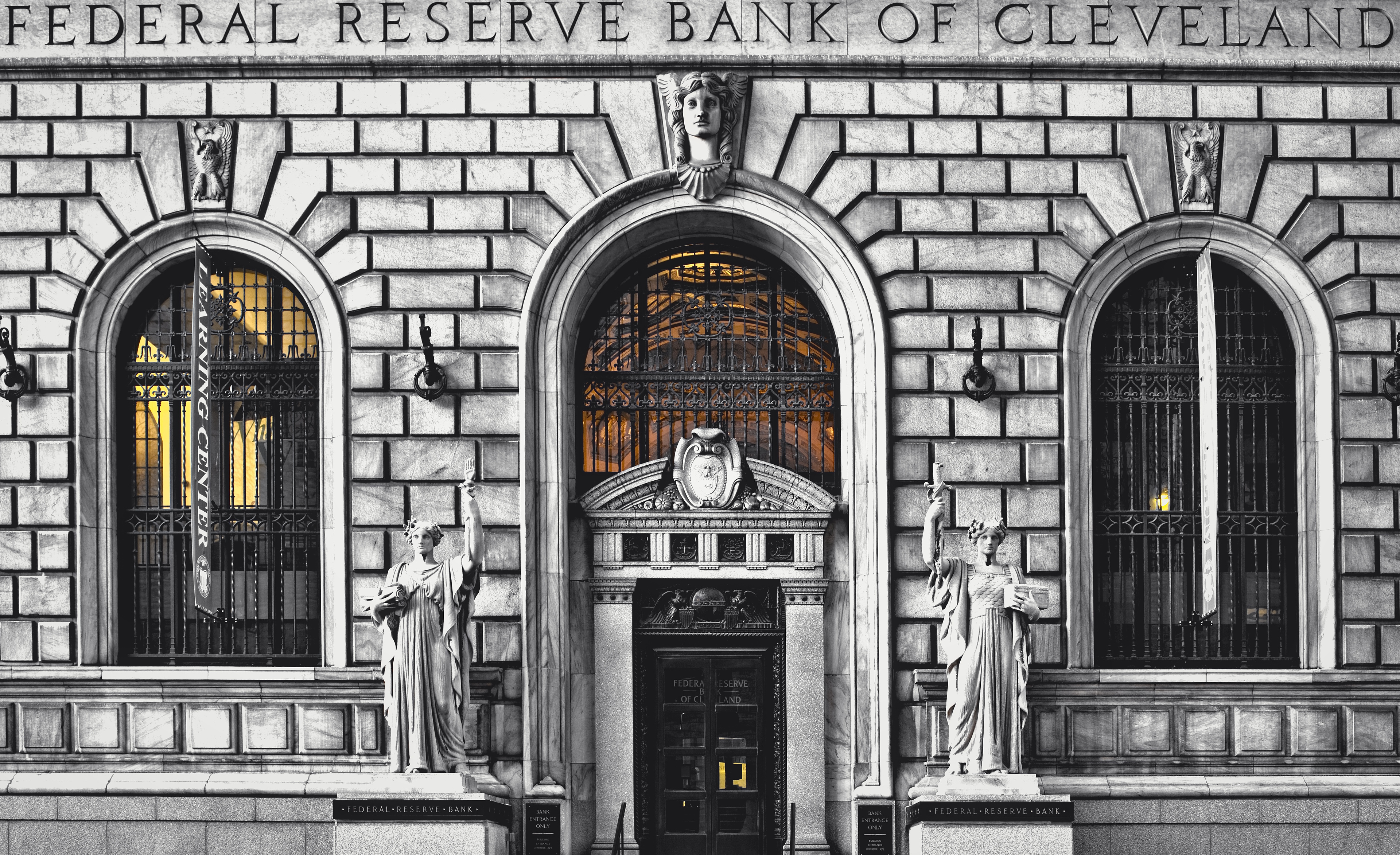
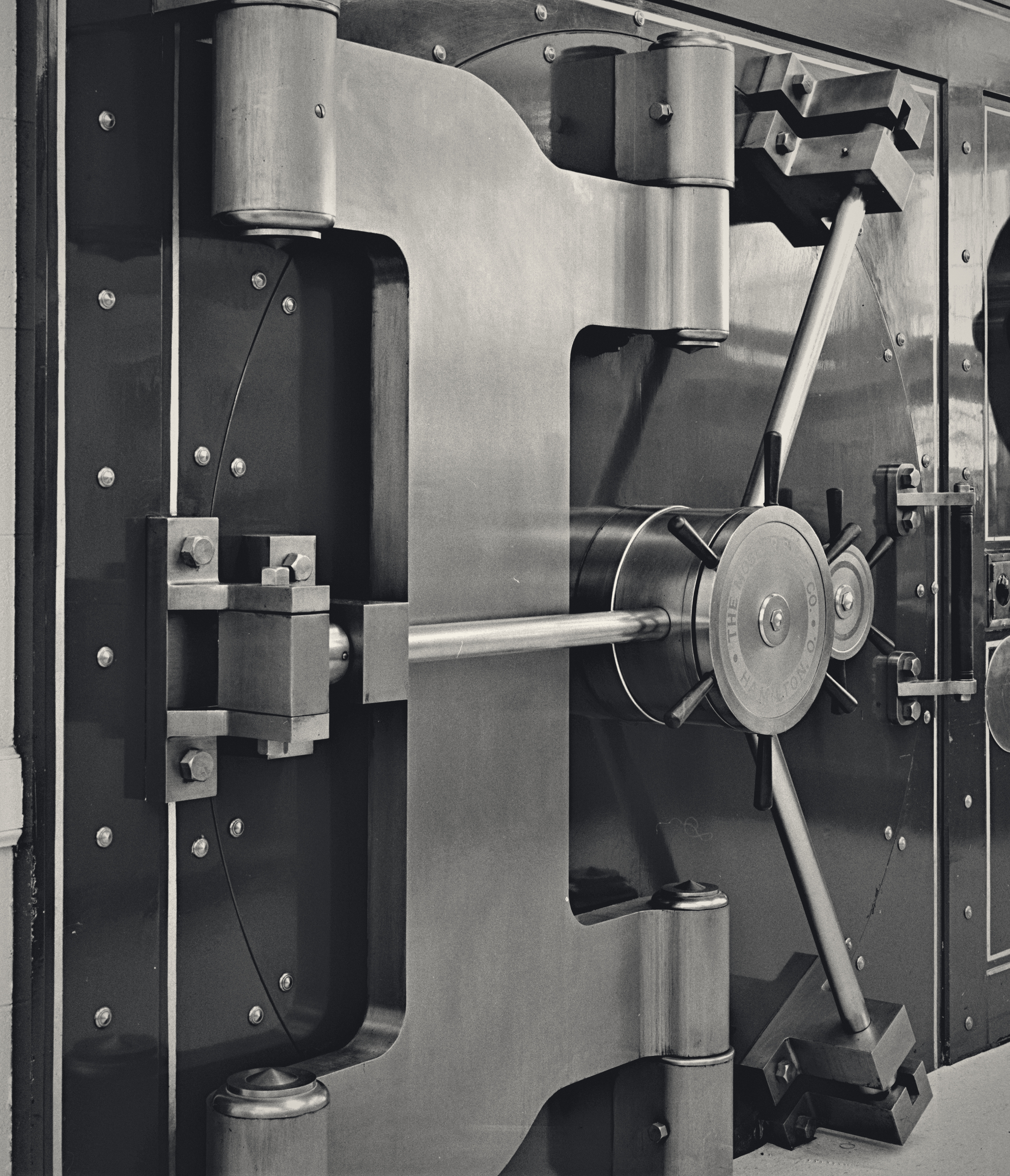
On August 23, 1923, the Federal Reserve Bank of Cleveland opened the doors of its new building at East Sixth and Superior, and an estimated 40,000 people walked through it that day. Walker and Weeks had designed it, in the bank's own account, to reflect safety and security. The vault door weighs 91 tons and is balanced so that one person can move it. The bank says it is still the largest vault door in the world.
The institution inside was not yet nine years old. The practice the building was made to house was sixty-three.
From November 1860, when a run reached New York, a committee of the city's banks issued clearing house loan certificates to the members that were short, and the members retired them when the run passed. The certificates were issued again in 1861, 1863, and 1864, and in each of the five panics that followed: 1873, 1884, 1890, 1893, and 1907. A history of the association published in 1904 put the total at $168,774,000, "and all were duly redeemed without the loss of a dollar." In 1906 the Chicago Clearing House Association brought in James B. McDougal to organize a bank examination department and began examining its members' books itself. When the Federal Reserve Bank of Chicago opened in 1914, he was its first governor.
The Federal Reserve Act was signed on December 23, 1913. The building in the photograph was finished in 1923.
The law is the last adopter. A requirement is somebody's habit — written down for everyone who did not have it, after the loss that made the habit visible. The dates in this piece come in pairs: the date of the habit and the date of the statute. The gap between them is where the institution stood.
Henry J. Heinz began bottling horseradish in Sharpsburg, Pennsylvania, in 1869, in clear glass. His competitors used colored glass, which hid what was in the jar. When food-safety advocates met President Roosevelt in 1905, Heinz's representatives went with them, while most of the industry worked to block any standard at all. The Pure Food and Drug Act became law in June 1906. The clear bottle was thirty-seven years old.
When the United States Steel Corporation published its first annual report in 1903, for the year 1902, the statements carried the certificate of Price, Waterhouse & Co. The New York Stock Exchange did not require an independent audit of a newly listed company until 1933 — and by then more than 90 percent of listed companies already had one. The Securities Act of 1933 wrote the habit into Schedule A: a balance sheet and a profit and loss statement "certified by an independent public or certified accountant." The certificate on the steel company's report was thirty years old.
Zachariah Allen could not get a rate credit for the fire protection he had built into his mill, so in 1835 he and other Rhode Island mill owners formed the Manufacturers Mutual Fire Insurance Company and insured each other. Every plant the mutual covered was inspected once a year.
In 1894, with modest support from two regional fire underwriters' organizations, William Henry Merrill, who had inspected the wiring at the 1893 World's Columbian Exposition, opened a laboratory above a fire patrol station with two employees and $350 of equipment. He ran the first test on March 24, 1894. The laboratory became Underwriters Laboratories.
In 1895 a group of insurance and property-protection men met in Boston because nine different standards for sprinkler pipe sizing and spacing were in use within a hundred miles of the city. On November 6, 1896, they voted to form an organization. Its first document was the sprinkler installation standard, which still carries the number NFPA 13, and the building codes cite it by that number.
The insurer carried the loss. So the insurer inspected the plant, tested the equipment, and wrote the standard. The codes came later.
The railroads are the other case. George Westinghouse patented the air brake on April 13, 1869. Eli Janney patented the knuckle coupler on April 29, 1873. Between 1877 and 1887 about 38 percent of railroad worker accidents happened at the coupling, where a man stood between two moving cars and set a pin by hand. The Safety Appliance Act was signed on March 2, 1893. Its deadline was extended, and the equipment was required on interstate cars from 1900. Coupling accidents fell from 11,710 in 1893 to 2,256 in 1902. Deaths at the coupling, per thousand trainmen, fell from 1.73 in 1889 to 0.78 in 1901.
The coupler had been patented for twenty-seven years when the law reached the cars. The loss fell on the brakeman — and the brakeman did not buy the cars.
Two older cases show what a control is made of. The Bank of Amsterdam opened in 1609 under the guarantee of the city. For most of two centuries its money traded at a premium to coin, the agio, because, as Adam Smith wrote in 1776, the bank "professes to lend out no part of what is deposited with it." Once a year the four reigning burgomasters visited the treasure, compared it with the books, and received it upon oath. That was the control. The bank never published a balance sheet. It had lent to the Dutch East India Company before Smith wrote, and in the war with England that began in 1780 the loans grew until they were the largest thing the bank held. In November 1790 the agio went below zero. In January 1791 the large account holders filed a formal protest with the city. The bank was liquidated in 1820.
The English Exchequer had a different kind of control. From the twelfth century it recorded a payment by notching a stick and splitting it lengthwise. The Exchequer kept one half, the stock, and the payer kept the other, the foil — and the claim was good when the halves matched. Nobody had to be trusted. The tallies were abolished in 1826. On October 16, 1834, two cartloads of them were burned in the furnaces under the House of Lords, and the fire took the Palace of Westminster. Dickens told it in 1855: "The stove, overgorged with these preposterous sticks, set fire to the panelling; the panelling set fire to the House of Lords; the House of Lords set fire to the House of Commons; the two houses were reduced to ashes."
The sticks had worked for seven hundred years. The order, in Dickens's words, was that they were "to be privately and confidentially burnt."
Community associations are the case at hand. The Foundation for Community Association Research counts 373,000 community associations in the United States in 2025, with 78.1 million residents. They collected $124.2 billion in assessments in the year and put $31.1 billion of it to reserves. They are run by 2,555,000 elected board members and appointed committee members, who gave 102.6 million volunteer hours.
What the law asks of their books depends on the state and the size. In Washington, an association with annual assessments of $100,000 or more must have its financial statements audited by a certified public accountant every year; below that line the owners may waive the audit by majority vote, year by year (RCW 64.90.530(2)). In Florida, a condominium budget has long had to include reserves for the roof, the paint, and the pavement, and the membership could vote, for any year's budget, "to provide no reserves or less reserves than required" (Fla. Stat. §718.112(2)(f)). The homeowners' association statute still reads that way (Fla. Stat. §720.303(6)(f)).
In October 2018 an engineer's field survey of Champlain Towers South in Surfside, Florida, reported "major structural damage" to the slab under the pool deck. On April 9, 2021, the board's president wrote to the owners that the damage in the garage "has gotten significantly worse" and put the work at about $15 million. The building fell at about 1:30 in the morning on June 24, 2021, and 98 people died. Senate Bill 4-D (SB 4-D) passed both chambers without a dissenting vote and was signed on May 26, 2022: a milestone inspection when a building reaches thirty years (Fla. Stat. §553.899), a structural integrity reserve study, and, for budgets adopted on or after December 31, 2024, no vote to waive the reserves for the items in that study (Fla. Stat. §718.112(2)(f)).
A board that commissioned the inspection at year thirty in 2015 was seven years ahead of the statute. Nothing required it.
A special assessment lands on whoever owns the unit on the day it is levied. The budgets that deferred the work were adopted years earlier, by other boards, and the people who chose the inspection firm, the reserve study, and the system that keeps the books are not the people who carry the loss. The second group changes every time a unit sells. The habit — where it exists — is kept by someone who will not be there when the bill comes.
In a set of books, the habit looks like this. Every entry passes one enforcement choke point before it exists, and the decision made there is written down and never edited. Each decision's hash includes the hash of the one before it, and every night the chain is recomputed and sealed into a snapshot. A posted entry is never changed; a mistake is corrected by a new entry that reverses it, and both stay on the record. The board sees every fee the processor charged, itemised. The association's CPA takes the whole set through a portal, every entry with its decision and a manifest that lists each file with its hash, in formats an auditor already reads, in a year when no statute asks for an audit as readily as in a year when one does.
No state requires any of this of an association's books. The clearing house certificates were not required either.
A habit decides what the law finds when it arrives.
The vault door in Cleveland is balanced so that one person can move it.
Images: Federal Reserve Bank of Cleveland, photograph by Carol M. Highsmith, Library of Congress, public domain. Vault door, Federal Reserve Bank of Minneapolis, Helena Branch, Historic American Buildings Survey, Library of Congress, public domain. Treatment by CommunityPay.
Sources: Federal Reserve History, "Federal Reserve Bank of Cleveland" and "Federal Reserve Act Signed into Law"; Gary Gorton and Ellis Tallman, "How Did Pre-Fed Banking Panics End?" (NBER Working Paper 22036), citing O. M. W. Sprague, History of Crises under the National Banking System (1910); Federal Reserve Bank of Chicago, "James B. McDougal"; The Henry Ford, "Heinz Bottle, 1869"; National Geographic, "How Henry Heinz used ketchup to improve food safety"; Baruch Lev and Feng Gu, The End of Accounting (2016), chapter 1; SEC Historical Society, "1930s: New Foundations"; Securities Act of 1933, Schedule A, items 25 and 26; The Henry Ford, Manufacturers Mutual Fire Insurance Company Records, finding aid; Insurance Hall of Fame, "Zachariah Allen"; UL, "Our History"; NFPA, "What Is the History of NFPA?"; U.S. Patents 88,929 and 138,405; Charles H. Clark, "The Development of the Semiautomatic Freight-Car Coupler, 1863–1893," Technology and Culture 13 (1972); Mark Aldrich, "History of Workplace Safety in the United States, 1880–1970," EH.Net Encyclopedia; Adam Smith, The Wealth of Nations (1776), book IV, chapter III; Stephen Quinn and William Roberds, "Death of a Reserve Currency," International Journal of Central Banking (2016); Science Museum Group, "Medieval Exchequer Tally Stick"; History of Parliament, "The Fire of 1834"; Charles Dickens, Speeches: Literary and Social (1880), the speech of June 27, 1855; Foundation for Community Association Research, 2025 U.S. National and State Statistical Review; Florida Senate, SB 4-D (2022D); NIST, "NIST Releases Technical Findings on What Caused the 2021 Partial Collapse of Champlain Towers South" (June 22, 2026); the Associated Press on the October 2018 field survey and the April 9, 2021 letter.
Scott Vuilleumier · Founder of CommunityPay, Inc.
Data science, investment banking, and financial systems engineering and ledger design.