Washington watches its condominiums being built. Florida watches them grow old.
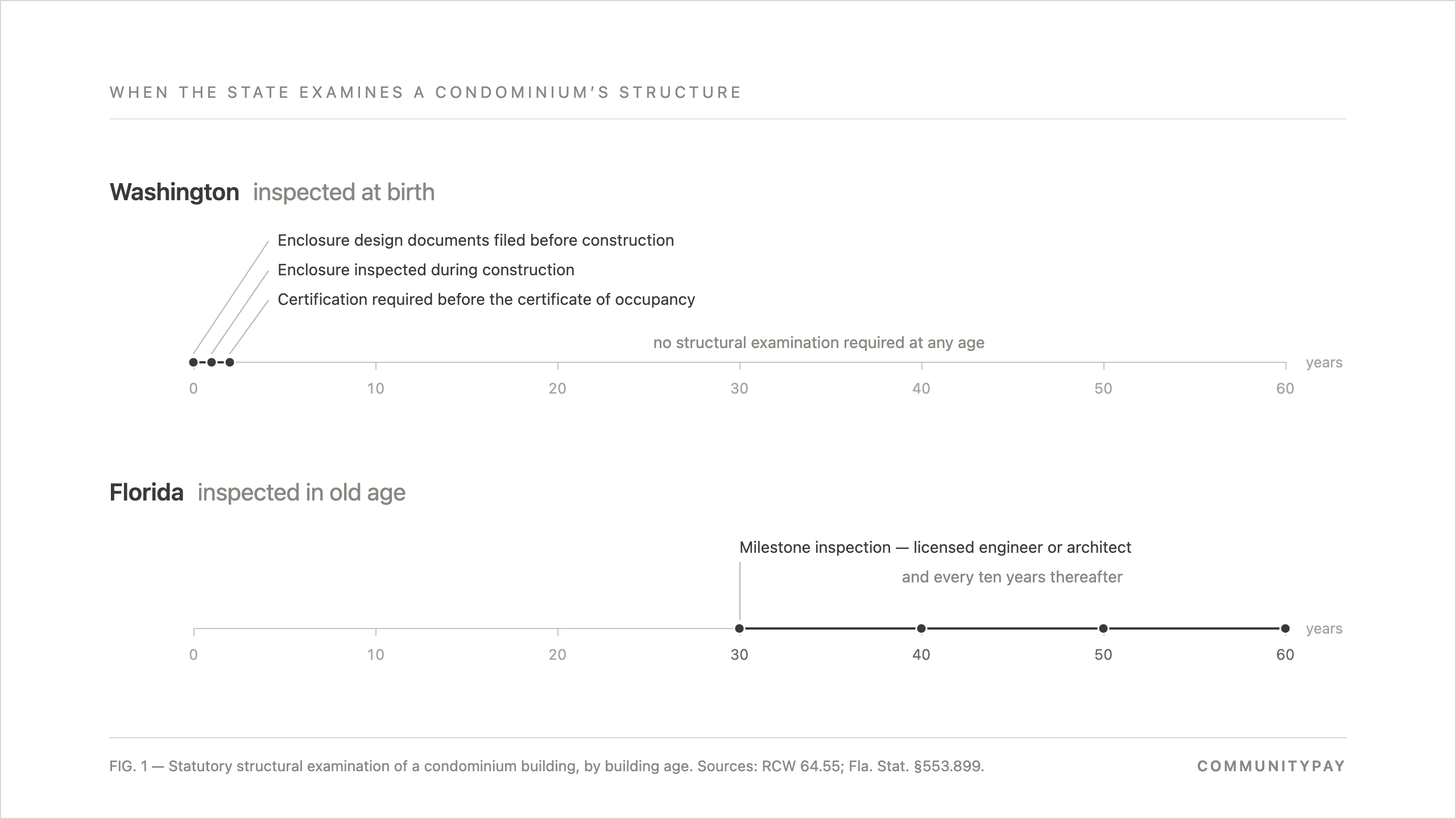
Washington State inspects its condominiums at birth. A multiunit residential building here must submit building enclosure design documents before work on the enclosure begins, have the enclosure — the walls, the windows, the waterproofing — inspected by a qualified inspector during construction, and file the inspector's certification before the building department may issue a certificate of occupancy (RCW 64.55). Buyers of new units carry statutory warranties of quality; for small buildings the insurance-backed alternative runs ten years on load-bearing structure (RCW 64.90.675).
Every one of those protections attaches to the first years of a building's life. After that, Washington law never asks to see the structure again. There is no age at which a standing condominium tower in Washington must be examined by an engineer. Not at thirty years. Not at fifty. Form 17 — the seller disclosure — asks the seller to check a box about structural condition, to the seller's actual knowledge (RCW 64.06.020). The reserve study, which WUCIOA requires and which must be grounded in a visual site inspection every three years (RCW 64.90.545), is a budget document prepared by a reserve professional. It prices the roof's replacement. It does not certify the load path under it.
Statutes Are Autobiographies
Each state legislates its last disaster. Washington's was the leaky-condo era of the 1990s — water inside the walls, a decade of litigation, builders abandoning the condominium form. The regime that followed watches buildings being born. Florida's was Surfside: ninety-eight people dead in a forty-year-old tower whose problems were documented three years before the collapse — no state law required anyone to act on the report. The regime that followed watches buildings grow old — a structural inspection by a licensed engineer or architect at year thirty, or twenty-five where local officials require it, and every ten years after (Fla. Stat. §553.899). New Jersey followed within three years: engineer inspections of every covered condominium and cooperative building's load-bearing system, beginning at year fifteen (P.L. 2023, c.214).
What the Market Reads in the Meantime
The secondary-mortgage system did not wait for statutes. At its last leaked count, in March 2025, the national ineligible-project list ran past five thousand condominium projects, more than seven in ten of them outside Florida. A lender's project review asks the same questions in Seattle that it asks in Miami — deferred maintenance, structural repairs, reserve adequacy. The difference is that the Miami building has been told what to measure, and the Seattle building is answering from memory.
The 2026 Session
Washington's condominium work this year went to the supply side. House Bill 2304 (HB 2304), effective June 11, 2026, widened the implied-warranty opt-out that makes small condominium buildings cheaper to build — two stories became four. It passed both chambers without a dissenting vote. The aging-stock question was not on the calendar.
Across the fifty states, two now require an engineer or architect to examine a standing condominium building's structure on a schedule. The other forty-eight ask at birth, or never. A standing state-by-state tracker of structural-integrity statutes is maintained here.
Washington built one of the strictest birth certificates in the country. It has never scheduled a checkup.
Florida is the state where the file exists. Washington is a state where no one has yet been required to open one. What happened to prices when Florida opened its file is the subject of The First Repricing.
Sources
- RCW 64.55 (building enclosure design documents, construction inspection, certification and certificate of occupancy)
- RCW 64.90.675 (express warranty insurance; ten-year coverage for structural defects to load-bearing members)
- RCW 64.06.020 (seller disclosure statement, Form 17)
- RCW 64.90.545 (reserve study; visual site inspection)
- Fla. Stat. §553.899 (milestone structural inspections)
- New Jersey P.L. 2023, c.214 (Residential Structural Integrity Law)
- Washington HB 2304 (2026 c 7; express-warranty eligibility expansion)
- Fannie Mae ineligible-project list counts (5,175 national / 1,438 Florida; leaked list dated Mar. 11, 2025): Wall Street Journal investigation, March 2025; see also National Mortgage News and Mortgage Professional America, Apr. 7, 2025 (Florida and tri-county counts)
Scott Vuilleumier · Founder of CommunityPay, Inc.
Data science, investment banking, and financial systems engineering and ledger design.