A core lesson from systems engineering is that most failures are not operational errors. They are predictable consequences of design decisions.
When a system allows:
- funds to be misclassified
- approvals to be bypassed
- payments to execute before validation
- reconciliation to happen later
Then errors are not anomalies — they are expected outcomes.
CommunityPay does not assume perfect behavior. It assumes pressure, ambiguity, and human fallibility.
The question we ask is not: What should happen?
It is: What must never be allowed to happen?
Control Must Precede Execution
In every mature engineering discipline, control systems and execution systems are deliberately separated.
Execution systems move things. Control systems decide whether movement is allowed.
Payments are an execution system. Accounting and governance are control systems.
Most financial software reverses this relationship:
- money moves first
- accounting reconciles later
- compliance is inferred after the fact
CommunityPay inverts the order.
Irreversible Actions Require Pre-Enforcement
In engineering, the strictest controls are always placed before irreversible actions. You can simulate a launch. You cannot simulate the consequences of an explosion.
Once money leaves an account, the system's leverage collapses. Recovery becomes legal, political, or interpersonal — not technical. The asymmetry is total: prevention is a system operation; recovery is a human one.
A bounced check can be retried. A misallocated reserve fund becomes a dispute.
This is why governance cannot live after execution. Control must exist upstream, where prevention is still possible. Every dollar disbursed without pre-validation is a decision the system can never take back.
How Governance Becomes Enforceable: Ledger-First Design
In CommunityPay, the ledger is not a passive record. It is an active control surface.
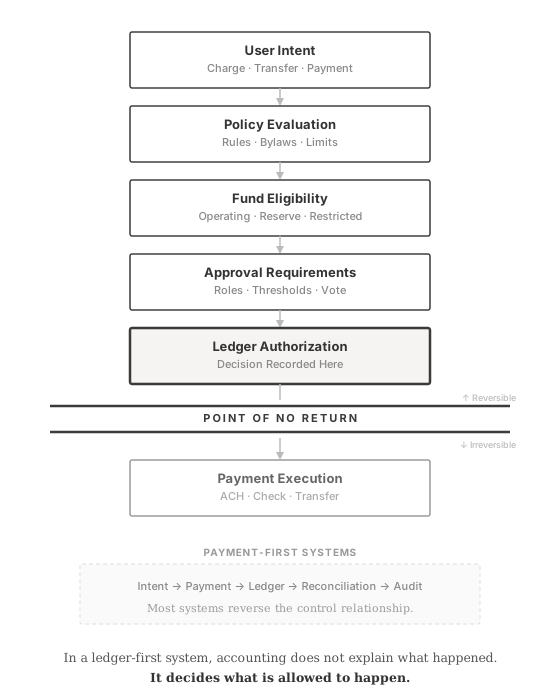
Every financial action follows the same sequence:
- Intent is declared — a proposed charge, transfer, or payment
- Policies are evaluated — fund restrictions, authority, approvals
- Eligibility is determined — allowed, denied, or escalated
- Journal entries are constructed — but not yet committed
- Execution is authorized only if governance conditions are satisfied
If a transaction fails at any step, money does not move.
This ordering is deliberate.
Traditional systems explain what happened. A ledger-first system decides what may happen.
Ledger-First Governance
Nothing irreversible happens until governance has finished thinking.
Negative Capability
Good systems are often judged by what they can do. Governance systems should be judged by what they cannot do.
CommunityPay is designed around negative capability — the deliberate removal of unsafe options from the system entirely. There is no toggle to disable fund enforcement. There is no override that bypasses approval chains silently. There is no path that allows money to move before policy is evaluated.
This is not a limitation. It is the source of trust.
System Invariants
Every governance system ultimately rests on a small set of non-negotiable truths.
In CommunityPay, these invariants are simple:
- Money cannot move before policy is evaluated
- Fund boundaries cannot be crossed silently
- Approval requirements cannot be bypassed
- Every decision must leave evidence
If an action would violate an invariant, it is not deferred, warned, or logged — it is prevented.
These are not design preferences. They are the testable laws the entire architecture enforces. Every concept in this series traces back to one or more of these invariants.
Guardrails, Not Rear-View Mirrors
Most financial systems are designed like rear-view mirrors. They tell you what happened after the fact. They help you explain mistakes. They document failure.
CommunityPay is designed like guardrails. It does not assume drivers will be perfect. It assumes roads are curved, visibility is limited, and mistakes will occur.
Good guardrails don't blame drivers. They prevent catastrophic outcomes.
Air traffic control systems do not rely on pilots to avoid collisions. They design airspace so that collisions are structurally unlikely. The role of the system is not to explain crashes — it is to prevent them.
This maps directly to ledger-first governance. The role of the system is not to document misallocations — it is to make them impossible.
Humans Are Variable Components
In quality systems and lean manufacturing, a critical insight is repeated again and again: when defects recur, the cause is almost never the individual. It is the system that made the defect easy.
HOAs rely on:
- unpaid volunteers
- rotating board roles
- part-time attention
- institutional memory that resets every few years
Designing systems that require perfect execution in that environment is irresponsible.
CommunityPay removes discretion from dangerous paths, makes correct actions the default, and records decisions automatically.
We do not ask boards to be perfect. We design systems that assume they are human.
Why Deliberate Architecture Feels Different
Systems that feel fast early are usually deferring complexity. Systems that feel deliberate early are usually absorbing it.
CommunityPay chose absorption over deferral.
We chose to invest time upfront in:
- a ledger that understands funds, not just balances
- policy enforcement before execution
- audit-grade decision traces
- governance expressed as code, not procedure
This feels slower at the beginning. In reality, it is where time is saved. The complexity does not disappear — it is resolved at the architectural layer, where it can be resolved once, rather than at the operational layer, where it must be resolved continuously.
Continuous Improvement Requires Structural Feedback
Systems do not improve through reminders or retraining alone. They improve through feedback that is built into the system itself.
By enforcing governance at the ledger and recording every decision path — approvals, denials, escalations — CommunityPay creates natural feedback:
- which rules trigger most often
- where governance is unclear
- where policies need refinement
This allows organizations to improve governance without rewriting manuals or retraining volunteers.
The system improves. People don't have to.
Designed for the Second Audience
Some systems are designed for users. Others are designed for the moments when no one is present to explain what happened.
CommunityPay is designed for the second audience — the moment explanation is no longer possible.
When a board turns over, when a manager transitions, when an auditor arrives, when a claim is filed — the system must speak for itself. Every decision, every denial, every escalation is recorded not because someone might ask, but because the system assumes someone will.
The Outcome Is Not Fewer Features — It's Fewer Failures
CommunityPay is not designed to be fast at everything. It is designed to be correct where correctness matters.
When money is governed:
- trust increases
- audits become simpler
- disputes decrease
- risk drops
- boards sleep better
That outcome is not accidental. It is the direct result of first-principles system design.
Closing Thought
Bad systems create predictable failures — and then blame the people inside them.
Good systems assume failure, design against it, and improve continuously.
Over time, organizations do not rise to the level of their intentions. They fall to the level of their systems.
CommunityPay was built on that distinction. Not because boards need more tools — but because they deserve better systems.
Further Reading
- Blanchard, B. S., & Fabrycky, W. J. Systems Engineering and Analysis
- Deming, W. E. Out of the Crisis
How CommunityPay Enforces This
- Governance enforced before execution — not reconciled after
- Unsafe options removed from the system entirely
- Every decision path recorded automatically
- Structural feedback built into the ledger, not dependent on retraining